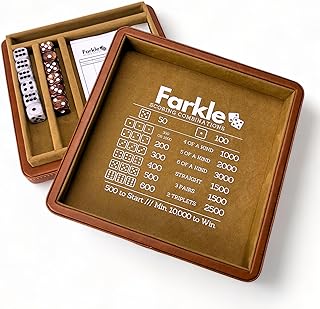
Farkle, a classic dice game of risk and reward, has captivated players for generations. Known for its simple premise but deep strategic possibilities, it's a perfect game for family gatherings, parties, or a casual game night. Whether you're a complete beginner or looking to refine your strategy, this ultimate guide will walk you through everything you need to know about Farkle, from the basic rules to advanced tactics that can help you consistently outscore your opponents.
At its core, Farkle is about knowing when to push your luck and when to bank your points. The thrill of the roll and the agony of a "Farkle" (rolling no scoring dice) is what makes the game so endlessly replayable. This guide will serve as your comprehensive resource, breaking down the official Farkle rules, explaining scoring in detail, and providing actionable strategies to improve your game.
What is Farkle? Understanding the Game
Farkle is a dice game traditionally played with six dice. Players take turns rolling the dice, setting aside scoring combinations, and deciding whether to continue rolling the remaining dice for more points or stop and bank their accumulated score for that turn. The primary objective is to be the first player to reach a predetermined winning score, often 10,000 points.
The game's history is somewhat fuzzy, with roots potentially tracing back to other dice games like 10,000 or Zilch. Its popularity surged with the commercial production of dedicated Farkle game sets, which often include dice, a cup, and a scorepad. The beauty of Farkle lies in its accessibility; the rules are easy to learn, but mastering the risk-assessment element takes practice and a cool head.
Official Farkle Rules and Scoring Breakdown
Before you can develop a winning strategy, you must have a firm grasp of the rules. While house rules can vary, here are the widely accepted standard rules for Farkle.
Basic Setup and Turn Structure
To start, you need six dice and two or more players. Players take turns in clockwise order. On a player's turn, they begin by rolling all six dice. After each roll, the player must set aside at least one scoring die (or combination). If no scoring dice are rolled, that's a "Farkle," and the player loses all points accumulated in that turn, passing the dice to the next player.
If scoring dice are set aside, the player faces a choice: Bank or Roll Again. Banking ends the turn, and all points from that turn are safely added to the player's total score. Choosing to roll again means picking up the remaining, non-scoring dice and rolling them, hoping to add to the turn's point total. However, if the subsequent roll yields no scoring dice, a Farkle occurs, and the player loses all points from that entire turn.
Farkle Scoring Chart
Understanding scoring combinations is crucial. Here is the standard scoring table:
- Single 1: 100 points
- Single 5: 50 points
- Three of a Kind: 1,000 points (1,1,1 = 1,000; 2,2,2 = 200; 3,3,3 = 300; 4,4,4 = 400; 5,5,5 = 500; 6,6,6 = 600)
- Four of a Kind: Double the three-of-a-kind score (e.g., 2,2,2,2 = 400)
- Five of a Kind: Triple the three-of-a-kind score
- Six of a Kind: Quadruple the three-of-a-kind score
- Straight (1-6): 1,500 points
- Three Pairs: 1,500 points
- Two Triplets: 2,500 points
Important Note: You must score a minimum of 500 points in a single turn before you can begin adding points to your overall game score. This is called "getting on the board."
Proven Farkle Strategies and Winning Tips
Now that you know the rules, let's dive into strategy. Winning at Farkle isn't just about luck; it's about calculated risk management.
1. The Golden Rule: Know When to Stop
The most common mistake beginners make is getting greedy. A good rule of thumb is to consider banking your points once you have 500-700 points in a turn, especially if you have only 1 or 2 dice left to roll. The probability of Farkling with few dice is high. If you have a very high score (e.g., 1,500+) in a turn, the risk often outweighs the potential reward.
2. The Opening Roll Strategy
Your first priority is to "get on the board" with 500 points. Be slightly more aggressive in your opening turns until you achieve this. Once you're on the board, your strategy should become more conservative relative to your position in the game.
3. Dice Management: What to Keep
Always maximize your scoring potential from a single roll. For example, if you roll a 1 and a 5, consider keeping both to score 150 points and leave yourself with four dice to roll, rather than just keeping the 1 for 100 points. However, if you roll three 2s (200 points) and a 1 (100 points), it's often better to just keep the three 2s, as this gives you three dice to roll instead of just two, increasing your chances of continuing your turn.
4. Playing from Behind vs. Playing with a Lead
Your position should dictate your aggression level. If you are far behind the leader, you need to take bigger risks to catch up. Be more willing to roll with fewer dice. If you are in the lead, adopt a conservative approach. Bank points earlier and more frequently to pressure your opponents into taking risks and potentially Farkling.
Common Farkle Variations and House Rules
Part of the fun of Farkle is the flexibility of its rules. Many groups play with variations that can change the game's dynamics. Here are a few popular ones:
- Spotting 10,000: Some rules require a player to hit exactly 10,000 points to win. If they go over, they revert to their score from the previous turn.
- Hot Dice Rule: If a player scores with all six dice, they get to roll all six again, continuing their turn. This can lead to massive point totals.
- Different Winning Scores: Games can be played to 5,000 for a quicker game or 15,000 for a longer, more strategic session.
- Penalty for Farkling with 500+ Points: Some versions penalize a player who Farkles after banking 500+ points in a game by deducting 500 or 1,000 points from their total score.
Why Farkle is the Perfect Family Game
Beyond the strategy, Farkle excels as a social and educational game. It's easy enough for children to learn, helping with basic math and probability skills. The fast-paced turns and shared suspense of each roll make it engaging for all ages. It requires no board, minimal setup, and is highly portable. Investing in a dedicated Farkle set can enhance the experience with durable dice and a convenient scoring track, but all you really need are six dice and a piece of paper.
Conclusion: Your Journey to Becoming a Farkle Champion
Farkle is a timeless game that perfectly blends chance and choice. By internalizing the official scoring, practicing disciplined risk assessment, and adapting your strategy to the game state, you can dramatically increase your win rate. Remember, the heart of Farkle is fun—the groans after a Farkle and the cheers after a huge score are what make it memorable. Grab some dice, gather your friends and family, and use the strategies in this guide to roll your way to victory. Will you bank your 650 points, or will you push your luck for glory?