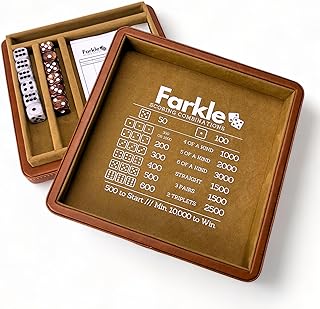
There's a special kind of magic in a simple game that can captivate players of all ages, requiring nothing more than a handful of dice and a bit of nerve. That magic is called Farkle, a classic dice-rolling game of risk and reward that has been a staple of family game nights, camping trips, and social gatherings for generations. At its heart, Farkle is beautifully simple: roll dice, score points, and decide when to stop before you lose it all. Yet, beneath that simplicity lies a deep well of strategy, excitement, and laughter that makes every round unpredictable and fun. Whether you're a seasoned player looking to sharpen your strategy or a newcomer curious about this beloved dice game, this guide will walk you through everything you need to know to enjoy and master Farkle.
What is Farkle? The History of a Timeless Dice Game
The origins of Farkle are somewhat shrouded in mystery, with roots that likely stretch back centuries to older European dice games. It shares DNA with games like 10,000, Zilch, and Cosmic Wimpout. The name "Farkle" itself is thought to be onomatopoeic, representing the sound of dice clattering together, or perhaps a playful term for a failed roll. What's undeniable is its rise as a modern classic game, beloved for its portability and the sheer, accessible thrill it provides. It requires no board, no complicated setup—just dice, a score sheet, and willing participants. This makes it the quintessential travel game and camping game, easily tossed into a backpack for instant entertainment anywhere, from a cozy living room to a mountainside picnic table.
Farkle Rules: How to Play Step-by-Step
The official rules for Farkle can have slight variations, but the core gameplay is consistent. Here’s a breakdown of how to play this engaging game for 2-4 players.
What You Need to Play
To play a standard game, you need six dice and a way to keep score. This is where a dedicated set like the Farkle Classic Dice Game shines. It includes six brightly colored dice for easy scoring recognition, a convenient dice cup for shaking and rolling (which also helps prevent lost dice under the couch!), and score sheets to track everyone's progress. Having a dedicated set elevates the experience from a makeshift game to a proper event.
Basic Scoring in Farkle
Scoring is based on specific combinations rolled. Each roll, you set aside scoring dice and can choose to re-roll the remaining ones. Here are the standard scoring dice:
- Single 1s: 100 points each
- Single 5s: 50 points each
- Three of a Kind: 1,000 points for three 1s. For other numbers, score 100 times the face value (e.g., three 4s = 400 points).
- Four, Five, or Six of a Kind: Score doubles the three-of-a-kind value for each extra die (e.g., four 4s = 800 points, five 4s = 1,600 points).
- Straight (1-6): 1,500 points.
- Three Pairs: 1,500 points.
- Two Triplets: 2,500 points.
The Turn Sequence: Risk vs. Reward
1. The Initial Roll: A player rolls all six dice.
2. Setting Aside & Re-rolling: After each roll, the player must set aside at least one scoring die. They can then choose to stop and bank their accumulated points for that turn, or continue rolling the remaining dice to try for more points.
3. The Hot Dice Rule: If all six dice score in a single roll, the player gets "Hot Dice" and can roll all six again, continuing their turn.
4. The Farkle! If a roll yields no scoring dice, the player has "Farkled!" They lose all points accumulated during that turn, and their turn ends immediately.
5. Banking Points: To end your turn safely, you must choose to stop rolling and add your turn's total to your overall score. The first player to reach 10,000 points (or another agreed-upon total) triggers the final round, where each other player gets one last chance to beat the leading score.
Advanced Farkle Strategy: When to Roll and When to Hold
While luck plays a role, skilled players know that strategy separates consistent winners from frequent "Farkle" victims. Here are key strategic insights:
- The 500-Point Entry Rule: Many versions require a player to score at least 500 points in a single turn before they can start adding to their overall score. This initial hurdle encourages aggressive, calculated risk-taking right from the start.
- Managing Dice Odds: The more dice you roll, the better your chances of getting a scoring combination. It's often safer to be aggressive when you have 4, 5, or 6 dice to roll. With only 2 or 3 dice left, the probability of rolling a non-scoring combination (and Farkling) increases dramatically.
- The Art of the Bank: There's no glory in Farkling with a massive turn score. A good rule of thumb is to consider banking your points once your turn total reaches 1,000 or more, especially if you are in the lead. In the final rounds, conservative play is often the winning play.
- Playing the Scoreboard: If you are far behind, you must take bigger risks to catch up. If you are far ahead, your goal shifts to banking safe points and forcing trailing players to take desperate, high-risk turns.
Why the Farkle Classic Dice Game is the Perfect Set
You can play Farkle with any six dice, but a dedicated set like the Farkle Classic Dice Game enhances the experience significantly. The included dice cup isn't just for show—it ensures a fair, random roll every time and contains the dice, making it ideal for playing on a picnic table, in a car (passengers only!), or on a camping blanket. The colored dice make identifying scoring combinations quicker and easier, especially for younger players. As a complete kit with score sheets, it transforms Farkle from a pastime into an event, perfect as a gift or as the centerpiece of your game collection. Its compact size cements its status as the ultimate travel game.
Farkle as the Ultimate Family and Party Game
What makes Farkle such an enduring family game and party game? Its accessibility is key. The rules can be taught in minutes, allowing grandparents, parents, and kids aged 12 and up to play on a level field. The turns are fast-paced, keeping everyone engaged. The collective groans when someone Farkles and the cheers when a player risks it all for a big score create shared memories and inside jokes. It encourages friendly competition without the complexity that can frustrate casual players. For parties, it's easy to run a Farkle tournament or play in teams, making it a versatile social lubricant.
Variations and House Rules to Spice Up Your Game
Part of Farkle's charm is its adaptability. Many families and friend groups develop their own "house rules." Here are a few popular variations:
- Spotlight on the 3s and 4s: Some versions allow three 3s to score 300 and three 4s to score 400, instead of requiring a minimum of 500 to enter.
- Penalty Farkle: In a meaner version, a Farkle might deduct 500 or 1,000 points from your total score, raising the stakes considerably.
- Steal the Dice: A fun, interactive rule where if you roll a scoring combination that matches another player's saved combination on the table, you can "steal" those points from them.
- Team Farkle: Play in teams of two, strategizing together on when to bank points, perfect for larger gatherings.
Conclusion: Rolling the Dice on Endless Fun
Farkle proves that the greatest games are often the simplest. It combines the primal thrill of chance with the cerebral satisfaction of strategy, all wrapped in a package that fits in your hand. Whether you're looking for a compelling family game night option, a reliable camping game that won't weigh down your pack, or a lively party game to break the ice, Farkle delivers. By understanding the rules, applying basic strategy, and investing in a quality set like the Farkle Classic Dice Game, you're not just buying a game—you're investing in countless hours of laughter, competition, and connection. So gather 2 to 4 players, shake those dice, and discover why this classic continues to be a roll above the rest.